

Before you go there’s plenty to organise from flights and accommodation to travel insurance and passports. But, have you considered how to make sure everything you own is protected for when you arrive back home? Here are some of our tips to get sorted before you go.
Protect your home
When we’re home our houses are usually safer, we can spot any damage before it worsens and we’re less vulnerable to break ins. Therefore most house insurance policies will have a limit to how long they’ll cover you whilst a home is vacant. So if you’re planning to be away longer, make arrangements before you head off.
Whilst you’re away make sure you’ve locked all your doors and windows and set any security alarms. You may consider having a trusted friend or family member house sit or ask a neighbour to keep an eye on your property for you.
Cover your stuff
Similar to your home, anything you leave in there is more vulnerable when you’re away. Before you go, check how long your contents are covered when your house is vacant. And, make sure to store any valuables out of sight and if possible in a locked safe.
Remember, although your contents policy may cover you when you’re away from home it’s unlikely you’ll be covered if you’re overseas. So make sure anything you’re taking with you, especially valuables like jewellery, are covered by your travel insurance.
Don’t forget about your car
Before you go, consider where you’re going to leave your car. If possible, store in a locked garage rather than on the street or in a driveway. If you’re using airport parking, take pictures of your car before you leave in case of any damage and don’t leave any valuables inside.
If you’re hiring a car whilst you’re away make sure you’re sufficiently covered through the hire company or your travel insurance for any accidental damage. And, don’t forget to bring your driver’s licence with you!
A chance to win the trip
If you’re still dreaming of your winter getaway, check out Haven’s referral competition for the chance to win a $4,000 travel voucher. Simply refer a friend or family member, or sit down yourself, for a no-obligation meeting with a Haven Adviser and you’ll both go in the draw to win. Terms and conditions apply.
A Haven Financial Adviser can help with insuring your house, contents and car. For more information and to book a meeting: https://haven.co.nz/travel/
Nigel Perkins, Head of Mortgages at Haven shares his commentary on the situation and how our advisers can assist you to get in front of it all.
What’s behind the continued Official Cash Rate increase?
Before yesterday’s OCR announcement, the general market sentiment was softening. Market swap rates (used as the yardstick for banks’ 1-5 years fixed rate pricing), were starting to head south, with some market commentary predicting some fixed interest rates had already peaked, even with future OCR increases already priced in.
General sentiment was one or maybe two more OCR increases of 0.25% were likely.
Instead, going against market sentiment, the Reserve Bank announced an increase of 0.5%. Pushing the OCR rate way beyond where the market had expected and reinforcing that inflation and the labour market are out of control. Although in retrospect, the Reserve Bank probably didn’t have much choice.
As an everyday Kiwi, if you hear that interest rates have peaked, you’re more likely to have confidence in your own spending, and you only have to weather a few more dark clouds before the sun is shining again.
‘Confidence’ is the fuel that fires inflation.
Make no mistake, the 0.5% OCR increase announced yesterday, has shut down any such confidence. And, is yet another blow to homeowners and business folk alike.
As the chart below suggests, the impact upon wholesale swap rates is immediate and the trends are the primary drivers of the banking sector’s fixed rate pricing strategy.
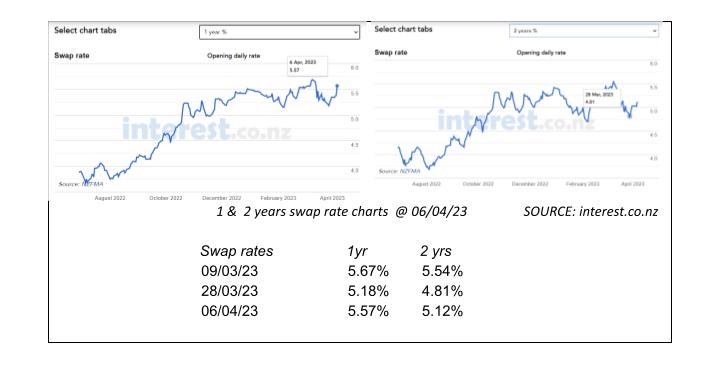
Short term rates will likely rise soon i.e., variable rates, through 1 year fixed rates. Interest rate increases sucks a lot of money out of the economy but ultimately, this is what the Reserve Bank needs to truly curb inflation.
If there were only hints of a recession previously, it is now a given. The fall from here will no doubt be hard. Household budgets will be stretched to capacity this year and some, beyond that. This is a cashflow crisis!
What can borrowers do to get in front of it all?
Right now, enquiries from clients are off the chart as people try to understand what sort of mortgage impact pressure is coming and what can be done to navigate it!
Our team can support borrowers to be as proactive as possible, explore if any extreme intervention is needed or if a simple tweak can help you ride out the storm ahead. With a few questions, we can understand your best options and give you confidence going forward.
Options could be:
When the property market goes slow, banks pivot and considerable incentives are made available to reward homeowners that shift their mortgage across to them. These incentives are in the form of cash, and are paid instantly upon changing over. Our role is to assess whether this is suitable for you, and if so, maximise the value to you.
So to get in front of it all, make it a priority to get in touch with a Haven Mortgage Adviser today!
With the slowing of the property market, we’re seeing less and less houses being sold on the auction floor. This means that houses are either being passed in, or buyers are purchasing by negotiation instead. But, what does that mean for the buyer and their strategy?
When buying a property there are two main ways to make an offer – having done your full due diligence on the property before making an offer, or making the offer subject to due diligence. There is no right or wrong way to make an offer, however the way you make the offer can impact your competitive advantage in navigating the deal.
When purchasing property at auction in a competitive market, serious buyers would’ve already done their complete due diligence on the property including lining up any pre-approved mortgage requirements. However in a slower and less competitive market where more properties are available to be negotiated upon, buyers tend to feel they can be less prepared. Unfortunately, this can lead buyers to miss out on a better deal.
Simply, as a buyer, the lesser conditions your offer has, the stronger your offer is. A seller is more likely to take your offer seriously if you’ve already done your due diligence, as they know that you’re a serious buyer who has done all the upfront work, in order to make the ‘no strings attached’ unconditional offer. This removal of procedural barriers can add a lot of appeal to your offer, and can in many cases, help you to negotiate a better price, as the seller may be more willing to accept a lower ‘as is’ price, to secure a sale.
So to put yourself in a strong position to negotiate, before making an offer on a property, you should understand:
By understanding all three areas of a particular property before making an offer, will put you in a strong and competitive position to negotiate.
So how can a Haven Mortgage Adviser help?
A Haven Mortgage Adviser can help you get your ducks in a row ahead of purchasing a property, whether it’s through auction or negotiation. They’ll advise you on the procedure, not just around finance, but guiding you through the whole process to ensure you’ve got the right actions in place, in order to get you in a position to maximise your circumstances in relation to property.
To optimise your circumstances, engage a mortgage adviser as early as possible in the process. Whether you’re considering buying a new home, or your first home, a Haven Mortgage Adviser can help you navigate the entire process.
Contact us for a no-obligation chat today about your home buying plans.
Nigel Perkins, Director at Haven Mortgages shares how the increased OCR will likely impact borrowers.
Behind the Official Cash Rate
“The double-edged sword of containing inflation vs responding to one of NZ’s most significant natural disasters is a mighty balancing act to navigate.
How the Reserve Bank looks at a red stickered Muriwai Beach homeowner in the eye and says, “You’ll have to pay up to 0.5% more for that mortgage on your home that you can’t access” – that’s incredibly tough when you’ve already been forced to pay to rent elsewhere, all while your insurance claim is a murky proposition, at best.
The OCR is a blunt macroeconomic tool designed to control the flow of money.
Right now, the flow of money couldn’t be more polarising. The sheer brutality of this monetary policy change will be the final straw for many Kiwi families, just to try holding on tight to what they’ve got!
So, what does the increase in OCR mean for you?
How much will rates actually rise? At this stage, you can reasonably expect all floating rate loans to pop up very soon.
We’re not expecting too much movement, if any, around the 2 yrs plus fixed terms (ie 2 yrs – 5 yrs).
Likewise, expect a good slice of the 0.5% increase to be passed through to terms up to 18 months, soonish.
How can Haven help your home loan with an increased OCR?
At Haven, we’re fully committed to ensuring the best options are navigated for every client’s unique circumstances.
These include:
When it comes to navigating fixed rates and mortgage negotiation, time is the enemy. The quicker you jump onto reaching out for assistance, the better the likelihood of providing the best options for your circumstances.”
Get in touch with the team today if you’d like a chat to see how Haven can help!
To help you avoid some of the common mistakes people make when buying insurance, we’re explaining some of these errors and why they may be more harmful than helpful.
1. Not having enough cover
If you’ve had insurance for a while now but haven’t updated it, you might be underinsured. This means that any new assets you have, or any life changes you’ve experienced, might not be covered should the worst happen. You need to review your cover regularly to account for these changes, but also to account for any market valuation changes.
For example, the value you set when you first took out your home insurance might be lower than it needs to be in the current market, potentially leaving you out of pocket should you need to rebuild.
2. Ignoring disclosure requirements
It’s important that you disclose all of the relevant information when taking out cover, particularly when it comes to medical insurance. A common mistake people make when buying insurance is that they don’t disclose their previous medical history, believing that it will make them ineligible for insurance, or that it will mean they have to pay higher premiums.
Unfortunately if you don’t disclose this kind of information, when you need to make a claim it may be denied. If you’re not sure whether something should be disclosed, include it anyway, or get advice from the professionals.
3. Putting it off
One of the most common mistakes people make when it comes to insurance is not getting any in the first place. The insurance-buying process can be complex and confusing, but with the right help, it can be a lot less stressful and will keep you protected when you need it.
This mistake is often made by those who are a bit younger, as they think they don’t need insurance just yet. The problem is that age often comes with an increase in health problems, and the longer you wait, the more you’ll end up paying. Getting insurance sorted as early as possible is key.
4. Taking out the cheapest cover
When it comes to insurance, you often get just what you pay for. That means that if you’re buying the cheapest cover option available, it’s likely not going to do what you need it to, when you need it. That’s not to say you need the most expensive and comprehensive insurance on the market, but it’s important to ensure that your cover is tailored to your specific needs and financial situation.
For the best cover options that work for your needs and your budget, it’s best to speak to an adviser. They know the available products and providers inside and out and can recommend types of cover that will keep you protected without blowing your budget.
5. Going it alone
As we mentioned, getting help from the professionals is absolutely key when it comes to avoiding insurance mistakes. A financial adviser can help you weigh up your options, and can explain your policy in a way that you can understand. They translate the jargon so you know exactly what you’re covered for, and where you might need more protection.
If you’d like to have a chat with one of our advisers at Haven, simply get in touch with us below – we’re here to help!
1. Make safety a priority
In any weather event, the safety of you and your family takes priority. Before you worry about the damages to your property or your items, make sure you head somewhere safe, warm, and dry if you need to evacuate. Be sure to take any essentials such as medication and warm clothing with you.
2. Take an inventory of your damaged items
When it’s safe to return to your property, you can begin to make a list of all of the damaged items. Note down as many details as you can about each item or part of your property – it’s a good idea to include the brand and make/model if you can. Gather together as many receipts for the items as you can to make the claims process easier.
3. Take photos of the damage
As well as listing the damaged items, it’s a good idea to take as many photos of the items as you can. Include photos of the items themselves, zooming in to capture any specific damage where necessary. If there’s been any damage to your house or surrounding property, be sure to take photos of this as well, especially if you will be moving anything for safety reasons.
4. Don’t dispose of damaged items straight away
Avoid disposing of any damaged items before an insurance assessor has a chance to look them over – even if they’re damaged beyond repair. If you need to move damaged items, do so with your safety in mind and make sure you’re wearing protective gear like gloves when handling any broken items.
5. Don’t try to drive your car
If your area has experienced flooding and your vehicle has been fully or partially submerged at any point, don’t try to start it or drive it. Even if it seems fine and the water has since dried, you never know what damage has been done to the engine or any electronic components. You should have your vehicle towed to the nearest mechanic for a safety assessment.
If you’ve been affected by the recent weather events and need some advice, feel free to get in touch with us. Stay safe out there everyone!
Take a look at what fund you’re in
If you were automatically enrolled in KiwiSaver through your employer and never actively chose which fund to be in, it’s likely you’re in a default scheme which is more conservative and might not grow as much as you’d like come retirement.
There are a few different types of funds available, so you’ll need to do a bit of research and figure out how much risk you’re willing to take and how long your money will be in that fund (i.e. if you’re likely to be withdrawing some of your KiwiSaver for a first home soon, you might want to be in a lower risk fund).
Check out your contributions
If you’re enrolled in KiwiSaver, you’ll be contributing 3%, 4%, 6%, 8%, or 10% from your salary. If you began at the lower end of the scale but have since received a pay rise, you could look at contributing more to boost your KiwiSaver. Even increasing a 3% contribution to 4% might make a healthy difference to your balance over the long run.
If you’d like to see how much more you can add to your KiwiSaver by increasing your contribution rate, check out our handy calculator.
What fees are you paying?
Because KiwiSaver is an investment, KiwiSaver providers charge different fees for managing your account. If you’re getting great returns you might be happy to pay more in fees, but it’s a good idea to check out what fees you’re paying because there may be a better option out there for you.
If you’re not sure what fees you’re paying, Sorted has a great tool called Fund Finder to help you compare.
You’ll need to prove your income
This part is the same as if you were applying for a home loan with a full-time PAYE job – the bank or lender still needs to know how much you earn.
Most banks or lenders will need the last two years of financial records, and will also likely require:
You’ll likely also need to produce bank statements, a declaration from your accountant, evidence of savings for your home loan deposit, and a good credit history.
You’ll need to provide information about your business and your experience
When you’re trying to win over a client, or participate in a networking event, you’re going to get asked what your business does, and what experience you have. This is partly because the person wants to know if you’re right for the job, but they also want to know that you’re legitimate and that you know what you’re doing.
The same goes for the banks and lenders. They’ll want to know more about exactly what you do in your business, and how much experience you have in your field. This will help them to determine how stable your business is and the kind of future it’s likely to have. Having this kind of information handy will help you in your endeavour to get a home loan.
Any financial inconsistencies will need to be explained
Even if your income has been low but steady, this can sometimes be more favourable to a lender than extreme highs and extreme lows. If you’ve had any major expenses or there have been some dramatic changes in your sales figures, you’ll need to have an explanation at the ready.
Knowing that your income might fluctuate is part of why banks and lenders have to be so critical with self-employed and contractor income – at any point, you may not be able to pay back your loan. The more careful and consistent you can keep your business finances, the better.
Seeking help from the professionals is key
When you’re self-employed and looking to apply for a mortgage, it’s best to get the professionals involved. This includes an accountant and a mortgage broker.
Your accountant can prepare your financials in a way that makes sense to the lender and clearly shows your financial position. They can even prepare cash flow forecasts to show likely income and expenses in future.
A mortgage broker can help explain exactly what is needed and work with you to get everything in order to give a well-presented picture of you to the bank or lender.
Self-employed and need help getting your home loan sorted? Come and chat with us. Our team of expert financial advisers can get you on your way to owning a brand new home.
1. Review your finances
If you haven’t actually reviewed your finances recently, perhaps your goal for this year will be to sit down and get into the nitty gritty of your money. You don’t have to do it all at once, but it’s important that you get a clear understanding of what you’re earning and what you’re spending so you know where you might need to make some changes. Maybe you can try to spend a bit less on takeaways, or hold a garage sale to make a bit of extra cash.
2. Create a budget
Many people believe a budget is restrictive and unrealistic, but it doesn’t have to be. Alongside setting aside money for your bills and other outgoings, also set aside some money for spending on whatever you like. If you’re saving for a holiday, you could make it more engaging by creating a visual representation of where you’re at (like the fundraising thermometers) to remind you of your goal.
3. Reduce debt
Taking control of your debt is one of the best goals you can make for your financial wellbeing this year. Plan to get rid of your most expensive debts, or ones with the highest interest rate first, like credit cards and overdrafts. Then work your way down to long term debts like your mortgage. If that seems too daunting, you can start with your smallest debts first, and then you’ll feel a much better sense of achievement at getting them out of the way fast.
4. Sit down with an adviser
If you’ve never had a chat with a financial adviser before, now’s the time. Make one of your financial goals this year to get in touch with an adviser you trust to help you get a handle on your finances. If one of your goals was to attend the gym more, or lose weight, you’d likely call in the professionals and get a personal trainer to help. Think of a financial adviser as a personal trainer for your finances!
Whether you want to create a budget, review your finances, or reduce debt, we’re here to help! No matter your financial situation, we’ll get you and your family set up for a brighter future.
Secure your home
When we’re out and about, it’s easy to lock up and leave our home, assuming that when we come back, it will be the same as we left it. Unfortunately, if we aren’t careful, break-ins can occur and our precious possessions can be stolen.
Whenever you’re leaving your home, even just for a day at the beach, be sure to lock all doors and windows and store your valuables out of sight. Try not to advertise on social media that you’re out, and if you’re going away for a longer period of time, have a friend or neighbour clear your mailbox and check on your home.
Check your car before you drive
If you’re heading out on a road trip, make sure that your car is in a safe condition to drive. Check the tread and the pressure of your tyres, and check that your headlights, horn, and wiper blades are in good working order. You’ll also want to ensure that your vehicle has a current registration and WOF.
It’s a good idea to take a look over your vehicle insurance policy so you know where you’re covered. For example, if you switch drivers halfway through your journey, you’ll need to make sure that your policy covers this.
Make sure your insurance is up-to-date
You might have received a high-value gift for Christmas, or made some renovations to your home that aren’t reflected in your policy. If you’re heading away for a break, it pays to make sure you have the right cover where you need it to avoid any nasty surprises.
Take photos and keep receipts of your valuables so that if you need to make a claim, you’ve got all of the details handy and can prove that you own the items and have evidence of the cost. This will help to get your claim approved faster, leaving you to relax and make the most of your trip.
If you need help making sure you’ve got the right cover, come and have a chat with one of our friendly insurance advisers. We can help you protect what matters most so you can go out and enjoy life.