

Test post
Lorem ipsum dolor sit amet, consectetur adipiscing elit. Mauris laoreet dui eu neque blandit consectetur. Fusce a sem maximus, varius ipsum et, dictum purus. Curabitur rhoncus est vel metus condimentum facilisis. Aenean ac purus fringilla, posuere enim sit amet, tempus eros. Quisque consequat vitae diam vitae pharetra. Morbi in imperdiet ex. Duis sit amet tristique nulla. Maecenas venenatis ante et efficitur aliquet. Proin ullamcorper blandit dui, at suscipit neque dignissim nec. Quisque vel placerat nibh. Ut et laoreet metus.
Morbi euismod, risus vitae porta tincidunt, tellus erat vestibulum arcu, sit amet faucibus lectus nibh id erat. Sed malesuada, quam nec fermentum tempor, velit elit dictum sem, non eleifend metus leo cursus nibh. Quisque ligula nulla, pulvinar ut vulputate at, posuere eu quam. Vivamus sit amet nunc elementum, aliquam erat at, consectetur ex. Quisque rutrum pulvinar nisl, eu rutrum nibh auctor sit amet. Integer et tempor justo. Aliquam erat volutpat. Praesent quis arcu cursus, iaculis tortor vitae, pharetra turpis. Cras tellus massa, sollicitudin et libero ut, consectetur placerat sapien. Integer magna mauris, dignissim posuere augue nec, elementum pharetra elit. Aenean vulputate sed arcu a euismod. Ut aliquam, neque vitae commodo bibendum, felis lacus tempor justo, et tempor orci elit eget ex.
Sed lobortis dolor vel aliquet rutrum. Etiam sed viverra mauris, et posuere mauris. Integer vulputate lobortis aliquam. Donec efficitur ut nisi vitae facilisis. Aenean congue massa et sem rutrum suscipit. Praesent at posuere sapien. In molestie libero id justo efficitur gravida. Nullam turpis neque, eleifend fringilla justo eget, efficitur feugiat justo. Phasellus rhoncus, diam vitae dictum cursus, diam ipsum semper purus, quis varius magna neque ac purus.
Understanding these factors is essential to building a solid foundation for your home-buying journey. Let’s break them down.
How much deposit is enough
Setting a realistic deposit goal is a great starting point. Your deposit size impacts your mortgage eligibility, potential interest rates, and overall loan costs.
Here are some key deposit benchmarks:
To understand your deposit in context, consider your Loan-to-Value Ratio (LVR). LVR is the percentage of your property’s value that you’re borrowing. For example, if you’re purchasing a home worth $700,000 and have a $140,000 deposit, your LVR would be 80%. Lower LVRs are preferred by lenders because they pose less risk.
Determine your borrowing power
Your ability to service debt is the second factor to consider, and it’s influenced by two key considerations:
Tips to strengthen your borrowing power:
Next steps: Start planning
Many first-time buyers find they’re closer to their goal than they think! If you’d like help assessing your current position and creating a personalised plan, reach out to us on 0800 700 699 or complete the form below.
*The information contained in this blog is for general information purposes only. It is not intended to constitute financial advice and does not take your individual circumstances and financial situation into account. We encourage you to seek assistance from a trusted financial adviser.
Looking for more support on your home buying journey? Visit our First Home Buyers Guide for helpful resources and step-by-step guidance.
Create a budget for your deposit savings
A structured budget is a powerful tool that helps you manage your finances and save effectively for your home deposit.
Evaluate your expenses and prioritise your needs over wants. Cutting back on discretionary spending and redirecting those funds into your deposit savings can make a big difference over time. Following this approach helps ensure you’re consistently saving and keeping your financial plan on track.
To start creating your budget, use the Sorted Budget Planner. It’s a great resource to help you put a plan in place that works for you.
Be purposeful with your budget
A great way to show the bank that you’re financially prepared for a mortgage is to ensure that the total amount you’re saving each month (excluding KiwiSaver contributions) plus your rent payments equals or exceeds what your mortgage repayments would be. This demonstrates to lenders that you can manage the financial commitment of a mortgage and strengthens your application.
Your budget isn’t a restriction but rather a tool to help you understand where your money is going. By using this understanding, you can prioritise your spending to align with your goals.
Strategies to boost your savings
Here are some practical tips:
Regularly reviewing and adjusting your budget is key to staying on track. Prioritise your deposit savings and maintain momentum.
Make the most of KiwiSaver
As long as you’ve been contributing to KiwiSaver for at least three years and intend to live in the home for at least the first 6 months, you’re eligible to withdraw all but $1000 of your KiwiSaver savings for your first home. Increasing your KiwiSaver contributions can be an effective way to build your deposit, as it’s automatically deducted from your income before, reducing the temptation to spend.
Next steps
Take time to sit down and develop a detailed budget. Review your current expenses, identify areas for reduction, and allocate as much as possible towards your deposit savings.
If you’re planning to use your KiwiSaver savings for your home purchase, it’s also timely to ensure you’re on track by booking a meeting with a Haven financial adviser. They’ll help make sure your KiwiSaver investment aligns with your goals.
Questions or need assistance? Contact us at 0800 700 699 or complete the form below, and we’ll be happy to help.
*The information contained in this blog is for general information purposes only. It is not intended to constitute financial advice and does not take your individual circumstances and financial situation into account. We encourage you to seek assistance from a trusted financial adviser.
Looking for more support on your home buying journey? Visit our First Home Buyers Guide for helpful resources and step-by-step guidance.
To help you explore this option, we’ve created a series of videos featuring our Head of Mortgages, Nigel Perkins. In these videos, Nigel breaks down the three most common ways family can help, along with the key considerations and risks for everyone involved.
Gifting
Family Loan
Guarantee
Next steps
If you’re thinking about approaching the Bank of Mum and Dad, it’s important to have a clear plan. Our advisers can help you understand your options and guide you through the process.
Got questions? Call us on 0800 700 699 or complete the form below, we’re here to help.
*The information contained in this blog is for general information purposes only. It is not intended to constitute financial advice and does not take your individual circumstances and financial situation into account. We encourage you to seek assistance from a trusted financial adviser.
Looking for more support on your home buying journey? Visit our First Home Buyers Guide for helpful resources and step-by-step guidance.
How’s your budget and deposit savings?
Your budget is the foundation of your savings plan, but life happens – sneaky expenses or rising prices can sometimes creep in and throw things off course. Have you noticed any changes to your spending? If so, it might be time to reassess your budget and make small adjustments to keep your savings on track.
Questions to consider:
A quick refresh of your budget can make a big difference!
Are you ready for pre-approval?
If your deposit savings are progressing well, it might be time to start thinking about pre-approval. This crucial step gives you a clear idea of how much you can borrow and makes you a stronger buyer when it’s time to make an offer.
Not ready yet? No worries, this is a great opportunity to check in with your Haven mortgage adviser. They can help you identify anything you may need to adjust or prepare to take the next step.
Next steps: Let’s chat
If you’re ready for pre-approval or just want to review your progress, our advisers are here to support you. Whether you have questions about your budget, deposit, or next steps, we’ll guide you through the process.
Call us on 0800 700 699 or complete the form below – we’re happy to help.
Keep going, you’re making great progress, and every step gets you closer to your first home!
*The information contained in this blog is for general information purposes only. It is not intended to constitute financial advice and does not take your individual circumstances and financial situation into account. We encourage you to seek assistance from a trusted financial adviser.
Looking for more support on your home buying journey? Visit our First Home Buyers Guide for helpful resources and step-by-step guidance.
Are you eligible for pre-approval?
An Haven mortgage adviser can help determine whether your current situation meets the criteria for pre-approval. Use the flowchart below as a general guide to assess your eligibility:
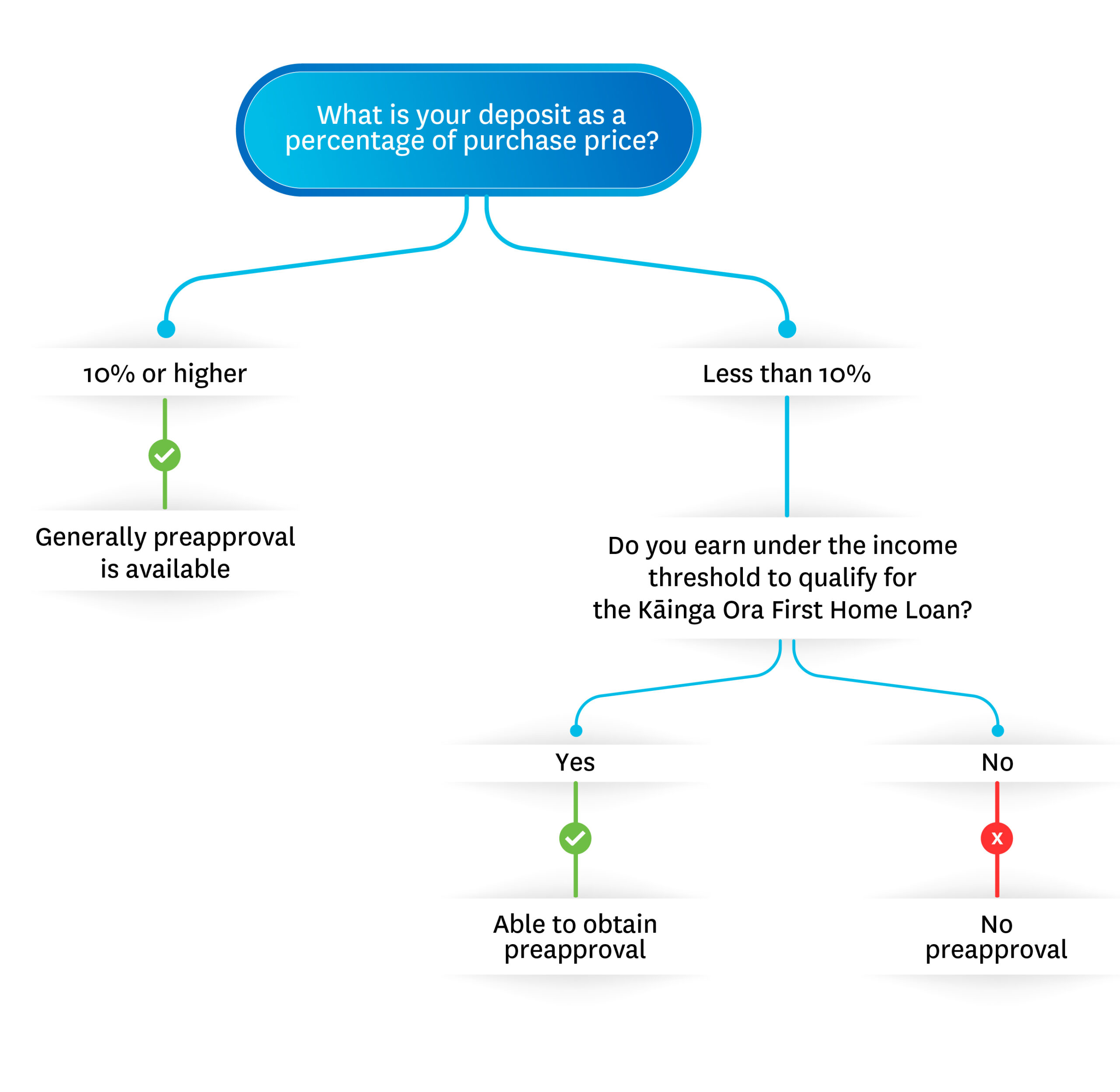
You can see the eligibility requirements for the Kāinga Ora First Home Loan here.
If your settings allow you to secure a pre-approval, this makes you more competitive in the property negotiation process. If your settings do not allow you to secure a pre-approval, your Haven mortgage adviser will work with you to navigate the property purchase process, which will likely include a conditional offer.
Your settings may also impact the types of properties and purchasing options available. The traffic light guide below outlines the options available, based on your deposit size:
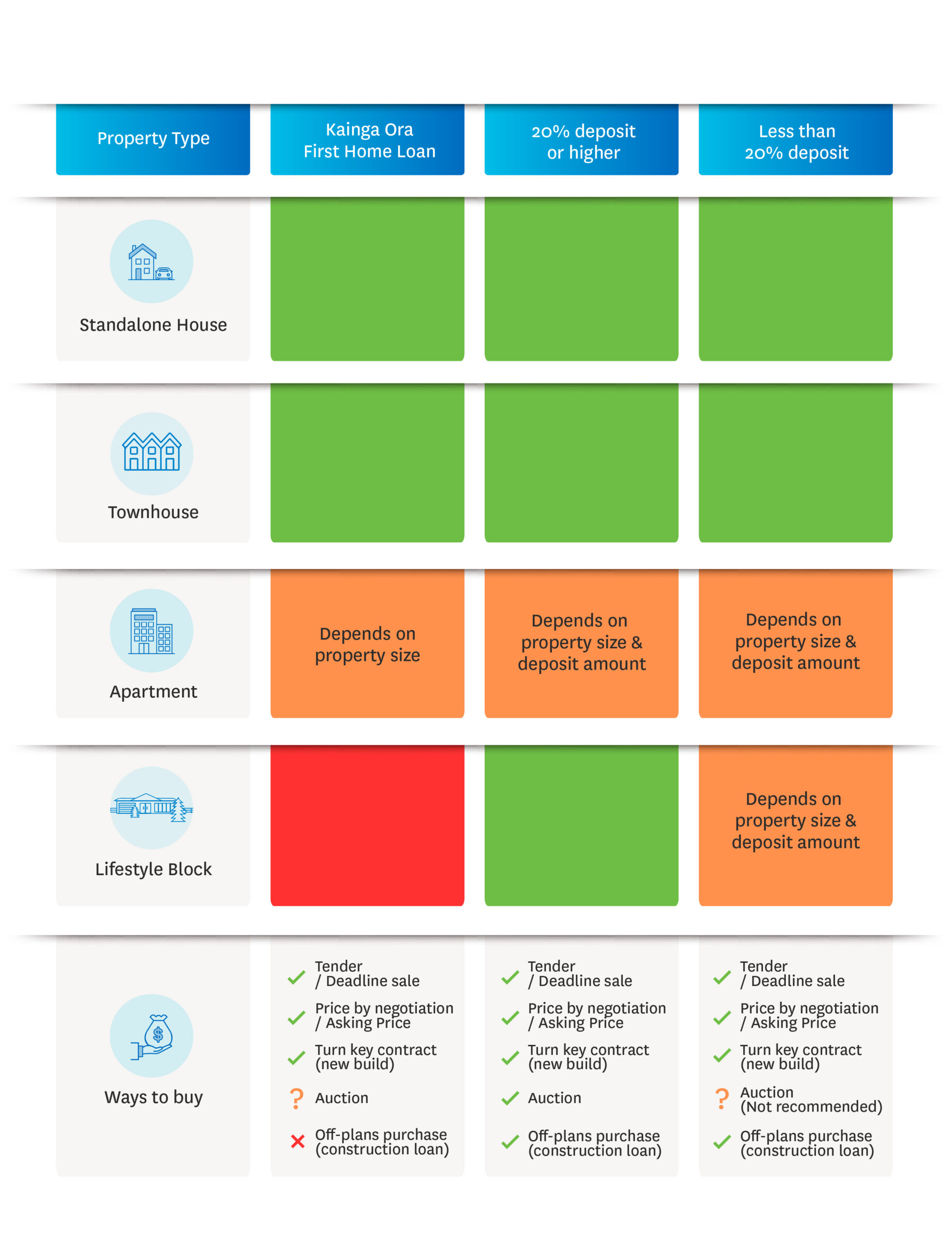
Making an application
When you think you’re ready to submit an application, you’ll need to provide your Haven adviser with a range of documents so they can guide you through the next steps. You’ll need to provide proof of income, proof of deposit, bank statements, statement of financial position (also known as a fact find), and identification.
Once your Haven mortgage adviser has assessed your documents, they’ll let you know if you are ready to submit an application or confirm that you are ready to go house hunting!
Next steps: Initiating your mortgage application
If your Haven mortgage adviser has determined you should progress to an approval (e.g. with a live contract) or a pre-approval, here’s what to expect:
Let’s get started
When you’re ready, send an email to mortgages@haven.co.nz, and we’ll send over all the requirements to get started with your application and how best to send your documents securely.
Haven Mortgages is here to support you through each step of your journey to owning your first home. Don’t hesitate to reach out if you have questions or need assistance.
Questions or need assistance? Contact us at 0800 700 699 or complete the form below, and we’ll be happy to help.
*The information contained in this blog is for general information purposes only. It is not intended to constitute financial advice and does not take your individual circumstances and financial situation into account. We encourage you to seek assistance from a trusted financial adviser.
Understanding property purchase methods
There are several ways to purchase a property, such as by negotiation, auction, or tender. Each method has its own set of rules and requirements, so it’s important to know which one suits your situation. Auctions, for example, require you to have your financing and due diligence completed beforehand (not recommended for those without pre-approval), while negotiation may give you more flexibility to discuss terms with the seller.
Use our free Haven Property Report
As you explore properties, take advantage of our free Haven Property Report to gain valuable insights into potential homes. The full report provides a comprehensive breakdown of the property details, surrounding area statistics, and an assessed value. To add real weight to your due-diligence on any property, request your Property Report here. Click here to see an example report!
Seek advice
Before making an offer, seek legal advice to ensure you understand the terms and implications of your purchase. Your Haven mortgage adviser can refer you to trusted legal professionals who offer preferential rates for this service.
Additionally, it’s essential to check the insurability of the house for mortgage purposes. At Haven, we work with trusted providers for house insurance, and our advisers can provide guidance on personal insurance cover, ensuring you’re protected and able to meet your mortgage obligations even in case of unexpected health challenges or life events.
You’ll also need to satisfy all your preapproval conditions before going unconditional.
Loan structures and settlements
When it comes to your mortgage, choosing the right loan structure is vital. You may consider fixed rates, floating rates, or a combination of both, depending on your financial situation and goals. Structuring your loan properly can help you manage your repayments effectively and maximise your financial stability. Your Haven mortgage adviser works with you to ensure your mortgage is optimally structured with a key objective to end up mortgage free faster!
Settlement is the final step where the property ownership officially transfers to you. This process includes linking with your solicitor to arrange the payment of any remaining deposit, executing mortgage documents, drawing down your home loan, and receiving the keys to your new home!
Talk to your adviser
Haven Mortgages is here to guide you through every step of the purchase and settlement process. We’re excited to help you take this final step towards owning your first home!
Questions or need assistance? Contact us at 0800 700 699 or complete the form below, and we’ll be happy to help.
*The information contained in this blog is for general information purposes only. It is not intended to constitute financial advice and does not take your individual circumstances and financial situation into account. We encourage you to seek assistance from a trusted financial adviser.
There are many reasons parents explore KiwiSaver for their children, including helping to grow their savings and teaching them good financial habits. However, there are a few key considerations to make when signing your kids up for KiwiSaver and some aspects that will differ until they are 18. Read our guide to make sure you understand how it all works before signing them up!
Joining KiwiSaver
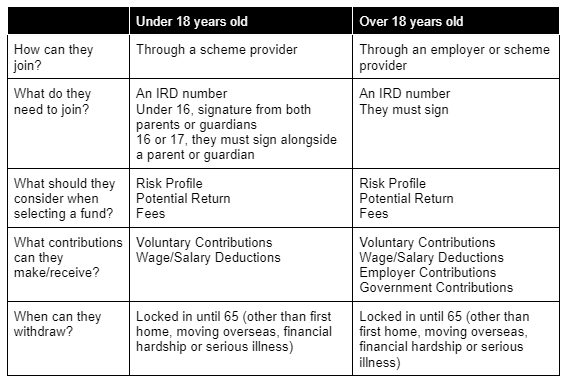
When signing your kids up for KiwiSaver, unlike over 18s, they can’t join through their employer even if they are working. They will need to join through a scheme provider and apply directly to them.
To apply, you’ll need their IRD number. If your child is under 16, both parents or guardians will need to sign the application form on their behalf. If your child is 16 or 17, they must sign the form alongside at least 1 parent or guardian.
Before signing your child up, consider the decision carefully as there is no option to opt-out even once they turn 18!
Selecting a fund
When signing your child up to KiwiSaver you’ll need to select a fund with your chosen provider to invest in. A Haven adviser can guide you through suitable options so you can consider carefully what fund is the best choice for your child currently. They will have the option to move funds again in the future.
Alongside considerations like risk and potential returns, you should look at the fees associated with a particular fund. As under 18s aren’t entitled to employer or government contributions, you don’t want your contributions to be eaten away by high fees.
Making contributions
For under 18s, the main way to contribute is through voluntary contributions. However if your child is working they will need to contribute a minimum of 3% of their wages or salary. Once they’ve been a member for 12 months they will have the option to take a savings suspension for 3 to 12 months.
Unlike over 18s, even if your child is working, their employer is not required to contribute. They also don’t qualify for the government contribution until they are 18.
Withdrawing
When you can withdraw your KiwiSaver is the same for all members. Generally, your money is locked away until you’re 65. However you may be able to withdraw funds to help buy your first home, if you’re permanently moving overseas, experiencing financial hardship or are seriously ill.
Summary
How can a Haven Financial Adviser help?
Our advisers are able to work with to help you decide which KiwiSaver fund is right for your child’s financial future. If you have any other questions, don’t hesitate to get in touch with our team.
Last month we held a webinar led by Nigel Perkins, Head of Haven Mortgages, and joined by legal guru Kelvin Mackie, from Mackie and Co Ltd. The webinar delved into invaluable strategies on navigating the rising market pressures for borrowers and emphasised the importance of proactive engagement when it comes to managing your mortgage. Read on for a summary of the discussion that took place.
The impact of Reserve Bank actions and rising interest rates
Over the past year, the Reserve Bank has responded to inflationary pressures by adjusting the Official Cash Rate (OCR) seven times, raising it from 2.0% to 5.50%. As a result, banks have increased their interest rates from record lows to record highs with best in market 1 year fixed rates surpassing 7% p.a. These changes have added to the financial challenges faced by households.
For more on what rising interest rates really mean for your mortgage repayments, including how to calculate your mortgage repayments using our online mortgage calculator, read our blog here.
Understanding the situation and the unique financial setting of each household
We are seeing more and more clients come to us to talk about their situation with their mortgage repayments, to understand what options are available to them. They want to understand what’s behind the numbers and how we can help them.
Now more than ever, every household should take the proactive stand of facing into their own financial circumstances. Regardless of the size of the mortgage, most households will need to somehow respond to the inflationary led changes and adapt accordingly. Each situation is unique, and it requires careful consideration to identify suitable options.
Exploring mortgage relief options
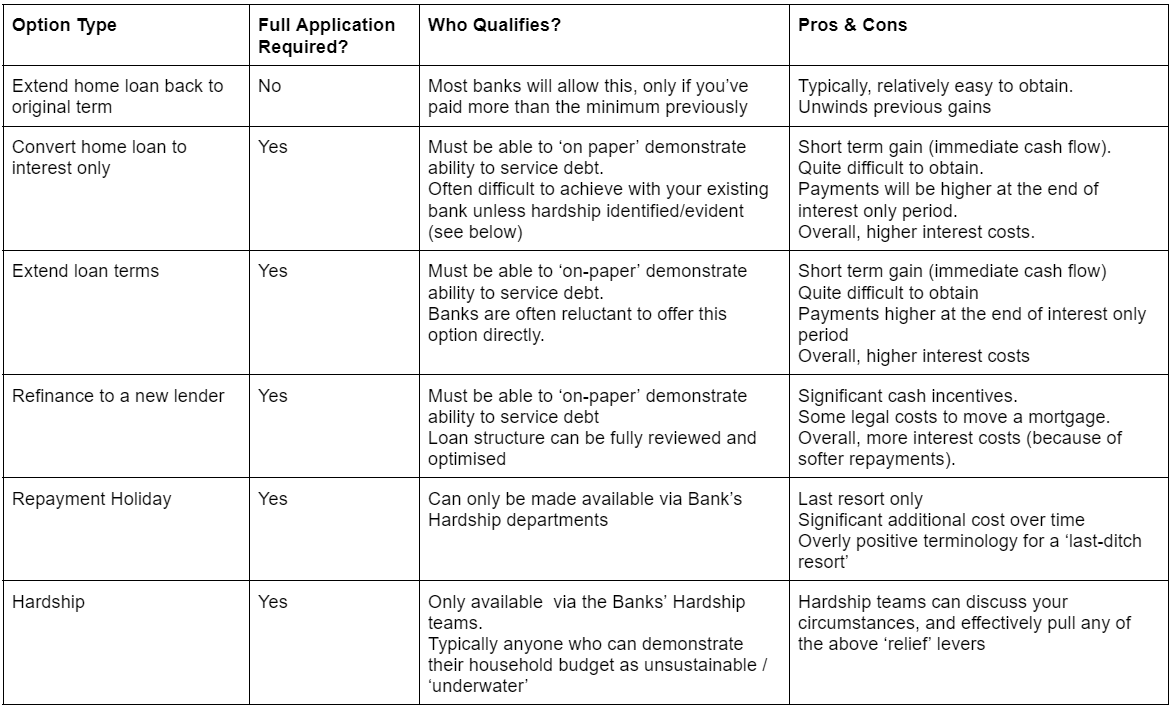
One possible response strategy, is to investigate the merits of softening the impact of interest rate changes. Some households may have the potential to consider and implement some form of mortgage relief. However, if such a plan is contemplated, it’s crucial to understand the associated qualifying thresholds, costs and implications of each option.
The following table outlines some of the possible mortgage relief options that could be made available:
Identifying available options
To identify the best available option to you, first you need to consider where you are at, including understanding your property value, your current lending settings, and your household budget. Get a good lens over what you are trying to achieve and if you’re expecting anything to change in the near future.
From there you can identify what options you may qualify for and whether they are suitable for your current situation. Consider that with a number of the above options you’ll need to show ‘on-paper’ that you can service your debt, for example with refinancing. To do this you’ll need to source a similar degree of information you supplied when you first applied for your loan and prove that you can still service the level of debt, relative to the bank’s servicing thresholds.
Remember that the majority of these ‘relief’ options come at an additional cost over the life of your loan. You should always firstly consider whether any other options are available i.e. reducing household spending elsewhere, and whether your current cash flow really warrants a relief option.
The importance of early engagement and seeking advice
A key takeaway from the webinar was the importance of engaging early to avoid a panic situation. It’s essential to face the reality of the situation as the later it is left the fewer options that will be available to you.
A great place to start is to speak with a Haven Mortgage Adviser to explore your situation and identify what options are available to you to get on top of the situation. Although a mortgage adviser cannot decide for you, they can provide you with their knowledge and education to empower you to make an informed decision.
In the face of the ongoing cost of living crisis, finding ways to reduce expenses has become a top priority for many families across New Zealand. One area where you may be able to make savings is on your insurances. Although ensuring you have adequate cover is important, there are some options you can look at to lower your insurance costs. Read on to explore some of these considerations.
Review your cover
Regularly reviewing your insurance to check you’re insured for the right things at the right amount is a great place to start when looking to reduce your insurance costs. Your circumstances change over time and so do your insurance needs.
For example, perhaps you’ve insured under 25 year old drivers to drive your vehicle but no one under 25 ever drives your vehicle. Therefore you could elect to remove this cover which will reduce your premium as the risk is seen to be lower. Another change in circumstance could be if you’re a smoker on your life insurance policy. If you’ve quit smoking (not smoked at all for 12 months) you can have your policy updated to a non-smoker which will reduce your premiums.
Bundle your insurances
The more insurances you hold with a single provider can help save you money as often it will mean you qualify for a multi-policy discount. You could also potentially save money when making a claim across multiple policies e.g. your house and contents are damaged in one event, as most providers will only charge one excess if you have both policies with them.
Upgrade your security
Ensuring you have a high level of security for your home, contents and vehicle could also reduce your insurance. Installing a security alarm at your home will reduce your premium with some insurers as your risk of burglary or damage to your property and contents is reduced. Also storing your vehicle in a locked garage rather than on the street or in your driveaway overnight can reduce your premiums.
Choose a higher excess
Another option available to lower the cost of your premiums is opting to pay a higher excess in the event of a claim on your house, car or contents insurance. Your nominated excess is the amount of a loss you’ll need to pay in the event of a claim.
However it’s important to consider whether you’d be able to easily access this amount of money in the event of a sudden and unexpected event. It also may mean you’re less likely to make a claim as it may not seem worth it if your excess is a similar cost to replacing something new anyway.
How can a Haven Financial Adviser help?
If you’re concerned about your premiums, speak to your Adviser before making any decisions about your cover. When speaking to your adviser, update them on any changes in your circumstances to help ensure you’re paying the right premiums for your current situation.